

Science
UK Skywatchers Prepare for 93% Partial Lunar Eclipse on Friday Morning
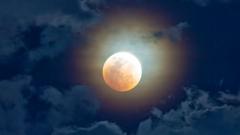
A significant partial lunar eclipse will be visible across parts of the United Kingdom in the early hours of Friday. At its peak at 05:12 BST, approximately 93% of the Moon will enter Earth's darkest shadow, creating a reddish hue shortly before moonset.
Atmospheric scattering to turn the Sturgeon Moon reddish during peak alignment at 05:12 BST, though cloud cover threatens visibility.
Executive summary
A significant partial lunar eclipse will be visible across parts of the United Kingdom in the early hours of Friday. At its peak at 05:12 BST, approximately 93% of the Moon will enter Earth's darkest shadow, creating a reddish hue shortly before moonset.
Overview
A major partial lunar eclipse is scheduled to take place across UK skies in the early hours of Friday, following a significant partial solar eclipse earlier this year. During the event, the Sun, Earth, and the full Moon—traditionally designated the Sturgeon Moon—will align, causing the lunar surface to dim and take on a reddish appearance.
Key Eclipse Timings
The astronomical sequence unfolds across several distinct phases on Friday morning:
- 02:23 BST: The Moon enters the penumbra, the faint outer zone of Earth's shadow. The subtle dimming during this phase will be largely imperceptible to most observers.
- 03:33 BST: The main partial phase begins as the Moon enters the umbra, the darkest central portion of Earth's shadow.
- 05:12 BST: The eclipse reaches maximum coverage, with approximately 93% of the Moon positioned within the umbra.
- 06:51 BST: The partial eclipse officially concludes. This final phase will not be visible from the UK, as the Moon will have set below the horizon.
Moonset timing varies by location across the country: 06:00 BST in Lerwick, 06:15 BST in London, and 06:42 BST in Enniskillen. Because the eclipse coincides with moonset, the low elevation on the south-western horizon will trigger the visual phenomenon known as the Moon illusion, making the lunar disk appear unusually large relative to terrestrial landmarks.
Atmospheric Science Behind the Red Hue
The reddish colour observed during an eclipse results from Rayleigh scattering within Earth's atmosphere. As sunlight passes through the atmospheric layers surrounding Earth, shorter blue wavelengths scatter outward, while longer red wavelengths pass through and are refracted toward the Moon. This light is then reflected back to Earth observers.
Weather Outlook and Viewing Risks
Astronomers recommend locating an elevated viewing position with an unobstructed view facing south-west. However, atmospheric conditions may limit visibility:
- Synoptic Conditions: Low pressure directly overhead brings local cloud coverage and showers across parts of the UK.
- Best Viewing Odds: The clearest skies are currently expected in East Anglia, south-east England, western Scotland, and Northern Ireland.
- Forecast Uncertainty: Slack winds associated with the low-pressure system make the precise positioning of cloud banks difficult to predict.
Sources
- BBC Science & Environment / Royal Observatory Greenwich
Institutional framing
TradingBase presents market updates in an institutional financial-news format. This is not investment advice.
NIC · Impact scores
Global: 48 · Market: 45 · Urgency: 43 · Confidence: 90 · Neutral
Themes: geopolitics
Asset impact
- US Stocks — Neutral (55) · US Stocks mentioned with balanced cues.
- Indices — Neutral (55) · Indices mentioned with balanced cues.
Market reaction
- SPX: Price snapshot pending · T-15m / T0 / T+15m / T+60m
- US30: Price snapshot pending · T-15m / T0 / T+15m / T+60m
Related knowledge
Ask AI about this article
Answers are grounded in the published article “UK Skywatchers Prepare for 93% Partial Lunar Eclipse on Friday Morning” and NIC scores — no invented figures.