

Economics
Dallas Fed Trimmed Mean PCE Inflation Rate Declines to 1.4%
The Dallas Fed's Trimmed Mean PCE price index registered an increase of 1.4% in June, down from 2.7% in May. This marks the lowest level since 2020 and contrasts with the headline PCE inflation rate of 3.7% and core PCE at 3.3%. The trimmed mean measure is designed to provide a clearer view of underlying inflation trends by filtering out extreme price fluctuations.
Latest figures indicate a significant drop from the previous month's 2.7%, highlighting a potential easing in inflation pressures.
Entities & knowledge links
Executive summary
The Dallas Fed's Trimmed Mean PCE price index registered an increase of 1.4% in June, down from 2.7% in May. This marks the lowest level since 2020 and contrasts with the headline PCE inflation rate of 3.7% and core PCE at 3.3%. The trimmed mean measure is designed to provide a clearer view of underlying inflation trends by filtering out extreme price fluctuations.
The Dallas Fed Trimmed Mean PCE price index was released today, showing an increase of 1.4% compared to 2.7% last month. This figure is notably lower than the headline PCE, which stands at 3.7%, and the core PCE at 3.3%, marking the lowest level since 2020.
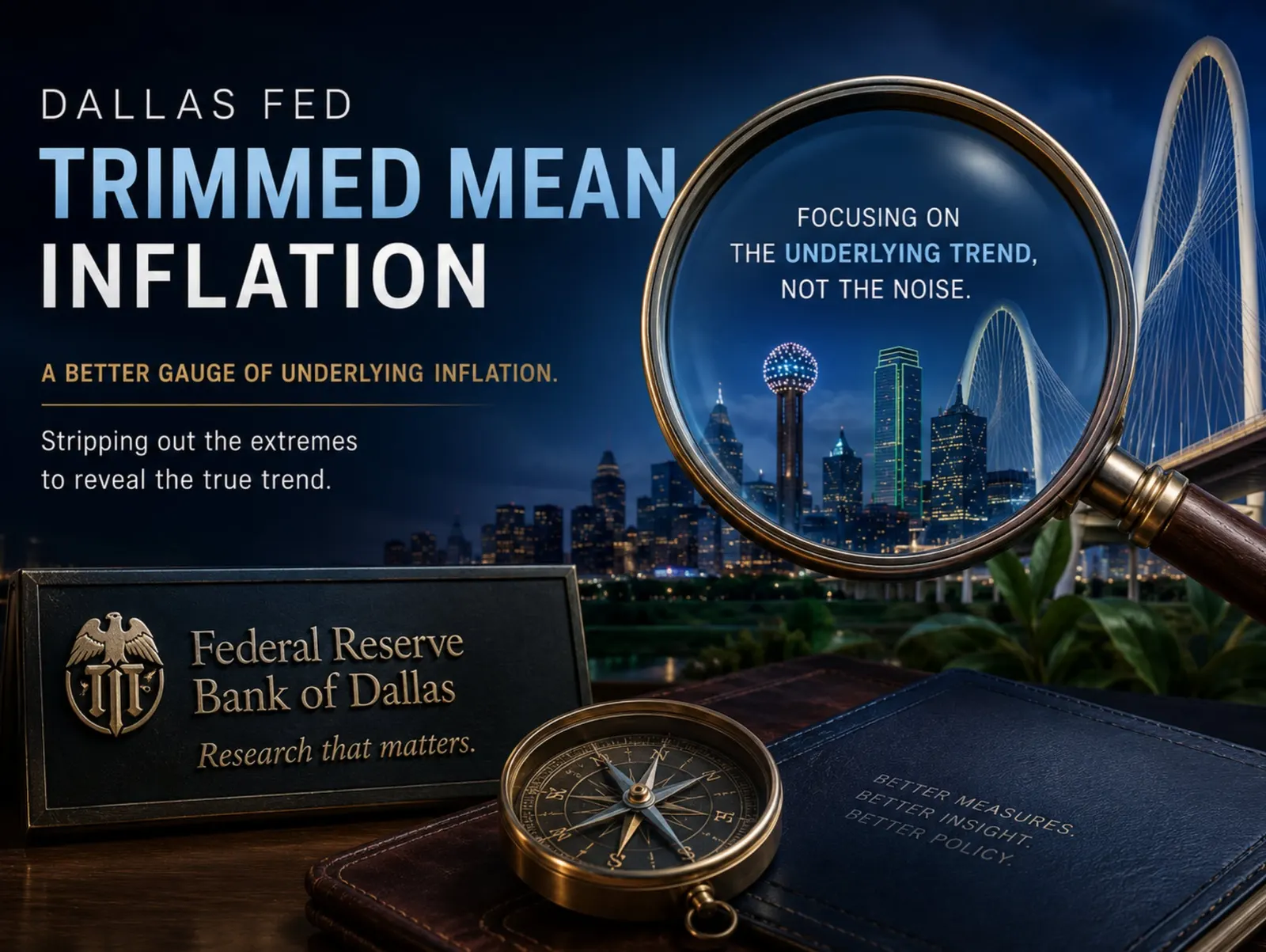
The Dallas Fed's Trimmed Mean PCE Inflation Rate serves as an alternative inflation measure that aims to eliminate the 'noise' from significant price movements, thereby offering a clearer picture of the underlying inflation trend. It utilizes the same data as the Fed's preferred inflation gauge, the Personal Consumption Expenditures (PCE) Price Index, but instead of excluding fixed categories like food and energy, it removes the most extreme price increases and decreases each month.
This methodology allows for a more stable inflation calculation, as it is less influenced by temporary supply shocks and one-off events that can distort headline inflation figures. For instance, if gasoline prices remain stable, they are included in the calculation, while an abrupt spike in medical services might be trimmed out.
Economists regard the trimmed mean as a reliable indicator of persistent inflation, as it tends to reduce monthly volatility and has historically been a good predictor of future headline inflation. The Dallas Fed's measure is closely monitored by Federal Reserve officials when assessing inflation pressures.
In a recent press conference, Fed Chair Warsh emphasized the importance of looking beyond a single inflation gauge, stating, "We want to understand the underlying trend in inflation, not simply react to individual data points." He reiterated that the trimmed mean is his preferred measure of inflation, advocating for improvements in how the true rate of inflation is measured in the U.S. economy.
While the latest data is encouraging, it is essential to note that one report alone will not significantly alter the inflation outlook. A sustained trend in lower inflation rates will be necessary before any material changes in policy are considered. Chair Warsh's comments suggest a cautious approach, indicating the need for further evidence before drawing firm conclusions about inflation measures and appropriate policy responses.
Institutional framing
TradingBase presents market updates in an institutional financial-news format. This is not investment advice.
Market watch
Track the economic calendar at Economic Calendar, price action at Markets, and signals at Signals.
NIC · Impact scores
Global: 97 · Market: 100 · Urgency: 53 · Confidence: 90 · Neutral
Themes: inflation, rates, geopolitics, energy, crypto
Asset impact
- Natural Gas — Neutral (55) · Natural Gas mentioned with balanced cues.
- ETH — Neutral (55) · ETH mentioned with balanced cues.
- US Stocks — Neutral (55) · US Stocks mentioned with balanced cues.
- Indices — Neutral (55) · Indices mentioned with balanced cues.
- Commodities — Neutral (55) · Commodities mentioned with balanced cues.
Market reaction
- NG: 6.01 → 6.01 (0%) · T-15m / T0 / T+15m / T+60m
- ETHUSD: 1918.0149999999999 → 1918.0149999999999 (0%) · T-15m / T0 / T+15m / T+60m
- SPX: Price snapshot pending · T-15m / T0 / T+15m / T+60m
- US30: Price snapshot pending · T-15m / T0 / T+15m / T+60m
- DJP: 47.39 → 47.39 (0%) · T-15m / T0 / T+15m / T+60m
Trading insight
Analysis only. Not a trade signal. Not investment advice. No Entry/TP/SL is generated by NIC.
Scenarios
- Two-way reaction likely until the market digests the data surprise vs forecast.
- Whipsaw risk is elevated inside the first 15–60 minutes after release.
- Watch correlated assets for confirmation rather than reacting to the headline alone.
Watch factors
- Actual vs forecast surprise (priced-in risk)
- USD / yields impulse if macro-sensitive
- Liquidity and spread during the news window
- Follow-through after T+15m / T+60m
- Relative reaction in natural_gas
- Relative reaction in eth
- Relative reaction in us_stocks
- Relative reaction in indices
Related events
Related knowledge
US June PCE Inflation Matches Expectations at 3.7%
Related news correlation
Macro & Gold Foundations
Macro-sensitive topic
White House Advisor Kevin Hassett Comments on Easing Inflation
Related news correlation
BoE Governor Bailey Addresses Inflation and Economic Outlook
Related news correlation
BoE Governor Bailey: Economic Indicators Suggest Caution
Related news correlation
Germany's July Inflation Rate Hits 2.8%, Slightly Above Expectations
Related news correlation
TradingBase Library
Research depth for related concepts
Ask AI about this article
Answers are grounded in the published article “Dallas Fed Trimmed Mean PCE Inflation Rate Declines to 1.4%” and NIC scores — no invented figures.