

Economics
Euro Area Economic Sentiment Rebounds in July
July data reveals a rebound in euro area economic sentiment, with consumer confidence and economic confidence readings improving. However, challenges remain due to geopolitical tensions and rising energy prices.
Consumer confidence and economic indicators show signs of recovery amid ongoing challenges.
Entities & knowledge links
Executive summary
July data reveals a rebound in euro area economic sentiment, with consumer confidence and economic confidence readings improving. However, challenges remain due to geopolitical tensions and rising energy prices.
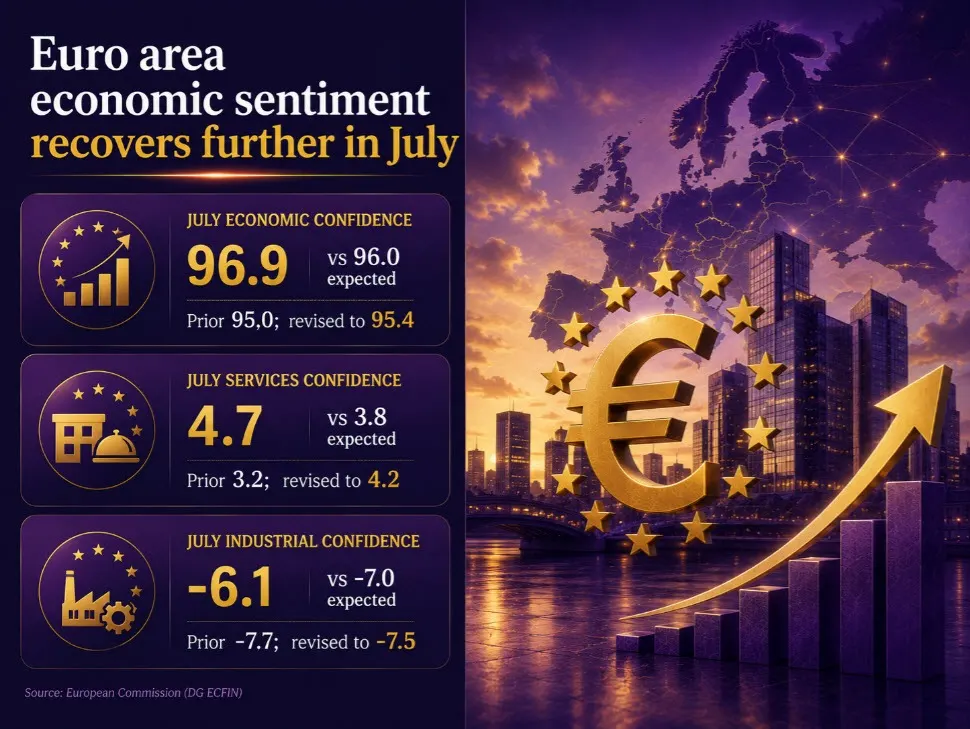
In July, final consumer confidence in the euro area remained unchanged at -15.9, matching preliminary estimates and showing an improvement from -17.6 in June. Economic confidence rose to 96.9, surpassing expectations of 96.0 and a revised figure of 95.4 from the previous month. Services confidence increased to 4.7, exceeding the expected 3.8, while industrial confidence improved to -6.1, better than the anticipated -7.0.
These figures indicate a continued recovery in economic sentiment, marking the highest confidence reading since February. The services and manufacturing sectors are both showing signs of rebound, contributing to this positive sentiment. Additionally, consumer inflation expectations have declined to 30.3 from 34.0, the lowest level since February.
Despite these positive indicators, economic headwinds persist as the euro area navigates the second half of the year. Geopolitical uncertainties, particularly related to the US-Iran conflict, alongside rising energy prices, present significant challenges. The European Central Bank (ECB) may need to raise interest rates to address these inflationary pressures.
While the risk of stagflation appears to be mitigated by recent economic resilience in Q2, the ongoing situation in the Middle East could continue to impact economic stability as autumn approaches.
Institutional framing
TradingBase presents market updates in an institutional financial-news format. This is not investment advice.
Market watch
Track the economic calendar at Economic Calendar, price action at Markets, and signals at Signals.
NIC · Impact scores
Global: 85 · Market: 90 · Urgency: 60 · Confidence: 90 · Bullish
Themes: inflation, rates, geopolitics, energy
Asset impact
- EUR — Bullish (67) · EUR leans bullish based on headline/body drivers.
- Forex — Bullish (67) · Forex leans bullish based on headline/body drivers.
Market reaction
- EURUSD: 1.1477499999999998 → 1.1477499999999998 (0%) · T-15m / T0 / T+15m / T+60m
- FX: Price snapshot pending · T-15m / T0 / T+15m / T+60m
Trading insight
Analysis only. Not a trade signal. Not investment advice. No Entry/TP/SL is generated by NIC.
Scenarios
- Continuation if confirmation holds after the news window.
- Whipsaw risk is elevated inside the first 15–60 minutes after release.
- Watch correlated assets for confirmation rather than reacting to the headline alone.
Watch factors
- Actual vs forecast surprise (priced-in risk)
- USD / yields impulse if macro-sensitive
- Liquidity and spread during the news window
- Follow-through after T+15m / T+60m
- Relative reaction in eur
- Relative reaction in forex
Related events
Related knowledge
Eurozone Q2 Preliminary GDP Grows by 0.4%, Outpacing Expectations
Related news correlation
Germany's Inflation Rate Expected to Rise in July Amid Accelerating State Readings
Related news correlation
Spain Inflation Estimated to Accelerate Further in July
Related news correlation
Spanish Economy Exhibits Resilience in Q2 with Growth Surpassing Expectations
Related news correlation
TradingBase Library
Research depth for related concepts
EUR/USD Holds Steady at 1.14 Resistance Ahead of FOMC Decision
Related news correlation
Ask AI about this article
Answers are grounded in the published article “Euro Area Economic Sentiment Rebounds in July” and NIC scores — no invented figures.