
Economics
Japan Services PMI: Growth Slows in July Amid Rising Prices
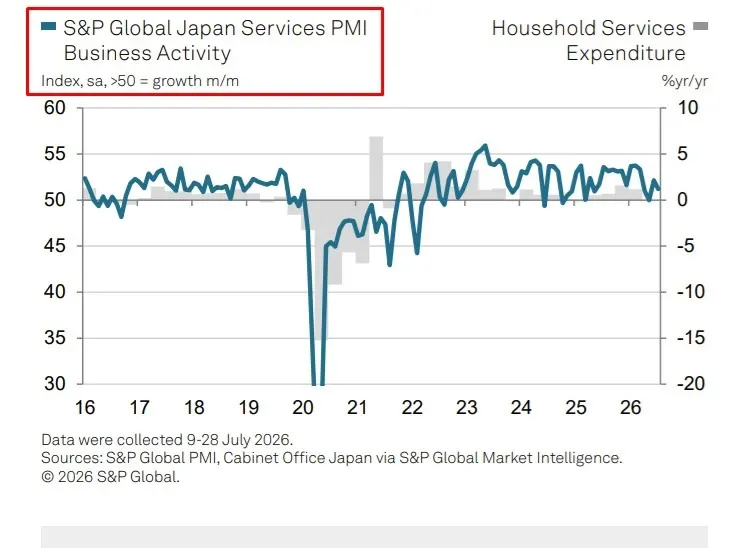
Japan's service sector growth decelerated in July, with the Services Business Activity Index falling to 51.2 from 52.2 in June. This slowdown, coupled with significant price increases, raises concerns about inflation and economic momentum, potentially influencing the Bank of Japan's policy decisions.
A decline in services growth and near-record price increases may compel the Bank of Japan to tighten monetary policy further.
Entities & knowledge links
Executive summary
Japan's service sector growth decelerated in July, with the Services Business Activity Index falling to 51.2 from 52.2 in June. This slowdown, coupled with significant price increases, raises concerns about inflation and economic momentum, potentially influencing the Bank of Japan's policy decisions.
The latest S&P Global Japan Services PMI indicates a slowdown in the service sector's recovery, with the Services Business Activity Index declining to 51.2 in July from 52.2 in June. This marks the second consecutive month of growth but at a significantly reduced pace compared to earlier in the year.
Total new business increased only marginally, reflecting the slowest growth rate in the current 25-month expansion. Foreign demand for Japanese services has also contracted for the fourth consecutive month, although the decline is easing.
Input costs surged sharply, nearing June's four-year record, driven by factors including the ongoing conflict in the Middle East, rising labor costs, and a depreciating yen. As a result, firms have implemented substantial price increases, leading to the second-sharpest rise in selling prices on record.
Employment growth has slowed, with backlogs of work increasing at their weakest rate in 17 months. Business confidence has moderated, attributed to supply chain disruptions, rising costs, an aging population, and labor shortages. This sentiment is among the lowest recorded since the pandemic.
At the composite level, which includes manufacturing, the S&P Global Japan Composite Output Index remained stable at 52.7, slightly down from 52.8 in June. The manufacturing sector has shown resilience, with output rising at its fastest pace since early 2014, offsetting the slower growth in services.
Annabel Fiddes, economics associate director at S&P Global Market Intelligence, noted that while the manufacturing sector's performance has been strong, the overall growth trajectory has shifted lower, particularly in light of escalating cost pressures and rising prices. The ongoing inflationary environment may prompt the Bank of Japan to consider further policy adjustments in the coming months.
Market impact
This article presents verified public information. Price reaction depends on liquidity and what was already priced in — no directional call is made here.
Institutional framing
TradingBase presents market updates in an institutional financial-news format. This is not investment advice.
Market watch
Track the economic calendar at Economic Calendar, price action at Markets, and signals at Signals.
NIC · Impact scores
Global: 56 · Market: 55 · Urgency: 50 · Confidence: 90 · Neutral
Themes: inflation, rates
Asset impact
- JPY — Neutral (55) · JPY mentioned with balanced cues.
- US Stocks — Neutral (55) · US Stocks mentioned with balanced cues.
- Indices — Neutral (55) · Indices mentioned with balanced cues.
- Forex — Neutral (55) · Forex mentioned with balanced cues.
Market reaction
- USDJPY: Price snapshot pending · T-15m / T0 / T+15m / T+60m
- SPX: Price snapshot pending · T-15m / T0 / T+15m / T+60m
- US30: Price snapshot pending · T-15m / T0 / T+15m / T+60m
- FX: Price snapshot pending · T-15m / T0 / T+15m / T+60m
Trading insight
Analysis only. Not a trade signal. Not investment advice. No Entry/TP/SL is generated by NIC.
Scenarios
- Two-way reaction likely until the market digests the data surprise vs forecast.
- Whipsaw risk is elevated inside the first 15–60 minutes after release.
- Watch correlated assets for confirmation rather than reacting to the headline alone.
Watch factors
- Actual vs forecast surprise (priced-in risk)
- USD / yields impulse if macro-sensitive
- Liquidity and spread during the news window
- Follow-through after T+15m / T+60m
- Relative reaction in jpy
- Relative reaction in us_stocks
- Relative reaction in indices
- Relative reaction in forex
Related knowledge
Japan Real Wages Rise for Sixth Consecutive Month, Bolstering Case for Future BoJ Rate Hikes
Related news correlation
US Treasury Secretary Bessent Comments on Yen and Bank of Japan Policy
Related news correlation
Bank of Japan Raises Interest Rate to 1.0% Amid Inflation Concerns
Related news correlation
Australia Services PMI Reaches Six-Month High of 53.6 Amidst Recovery in New Orders
Related news correlation
Fed's Paulson: Monetary Policy Decisions Are Clear-Cut
Related news correlation
Library
Research depth for related concepts
Ask AI about this article
Answers are grounded in the published article “Japan Services PMI: Growth Slows in July Amid Rising Prices” and NIC scores — no invented figures.