
Economics
New Zealand Unemployment Rate Rises to 5.6%, Highest in 11 Years
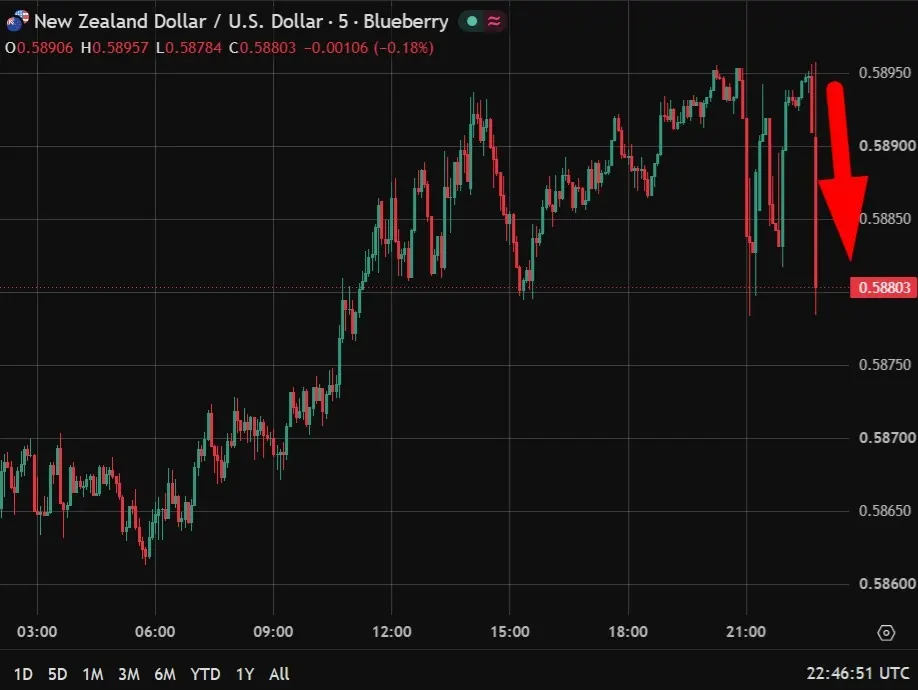
New Zealand's unemployment rate increased to 5.6% in Q2, surpassing expectations of 5.4% and up from 5.3% in the previous quarter. While employment grew by 0.5% quarter-on-quarter, indicating robust hiring, the rising jobless rate suggests a cooling labour market. Wage growth also exceeded forecasts, complicating the outlook for monetary policy.
Labour market shows signs of cooling despite stronger employment and wage growth.
Executive summary
New Zealand's unemployment rate increased to 5.6% in Q2, surpassing expectations of 5.4% and up from 5.3% in the previous quarter. While employment grew by 0.5% quarter-on-quarter, indicating robust hiring, the rising jobless rate suggests a cooling labour market. Wage growth also exceeded forecasts, complicating the outlook for monetary policy.
New Zealand's unemployment rate has climbed to 5.6% in the second quarter, marking an 11-year high and exceeding economists' expectations of 5.4%. This increase from 5.3% in the previous quarter indicates a labour market where more individuals are seeking employment than the economy can currently accommodate.
Despite the rise in unemployment, the employment change figure showed a robust growth of 0.5% quarter-on-quarter, significantly higher than the anticipated 0.1%. This suggests that hiring has not decelerated as sharply as the headline unemployment rate might imply. Additionally, the participation rate rose to 70.7%, up from 70.4%, indicating that more people are entering the workforce.
Wage growth also outperformed expectations, with the Labour Costs Index increasing by 2.1% year-on-year, up from 2.0%, and a quarterly rise of 0.7%, exceeding the forecast of 0.6%. This persistent wage growth alongside a rising unemployment rate presents a mixed signal for policymakers, as it indicates ongoing cost pressures in the labour market even as slack appears to be building.
The Reserve Bank of New Zealand (RBNZ) is likely to consider these mixed signals as it evaluates its monetary policy strategy ahead of its next meeting on September 2. The significant rise in the unemployment rate is expected to draw considerable attention, but the strength in employment growth and wage increases suggests a more nuanced economic landscape than the headline figure alone would indicate.
Market impact
This article presents verified public information. Price reaction depends on liquidity and what was already priced in — no directional call is made here.
Institutional framing
TradingBase presents market updates in an institutional financial-news format. This is not investment advice.
Market watch
Track the economic calendar at Economic Calendar, price action at Markets, and signals at Signals.
NIC · Impact scores
Global: 44 · Market: 40 · Urgency: 43 · Confidence: 90 · Bullish
Themes: rates
Asset impact
- Indices — Bullish (67) · Indices leans bullish based on headline/body drivers.
Market reaction
- US30: Price snapshot pending · T-15m / T0 / T+15m / T+60m
Trading insight
Analysis only. Not a trade signal. Not investment advice. No Entry/TP/SL is generated by NIC.
Scenarios
- Continuation if confirmation holds after the news window.
- Whipsaw risk is elevated inside the first 15–60 minutes after release.
- Watch correlated assets for confirmation rather than reacting to the headline alone.
Watch factors
- Actual vs forecast surprise (priced-in risk)
- USD / yields impulse if macro-sensitive
- Liquidity and spread during the news window
- Follow-through after T+15m / T+60m
- Relative reaction in indices
Related events
Related knowledge
US Treasury Secretary Bessent Comments on Yen and Bank of Japan Policy
Related news correlation
Fed's Paulson: Monetary Policy Decisions Are Clear-Cut
Related news correlation
Fed's Paulson: Underlying Inflation Remains Elevated
Related news correlation
Federal Reserve Chair Warsh Considers Reducing Meeting Frequency
Related news correlation
Atlanta Fed GDPNow Growth Estimate Increases to 6.2%
Related news correlation
Library
Research depth for related concepts
Ask AI about this article
Answers are grounded in the published article “New Zealand Unemployment Rate Rises to 5.6%, Highest in 11 Years” and NIC scores — no invented figures.