
Finance
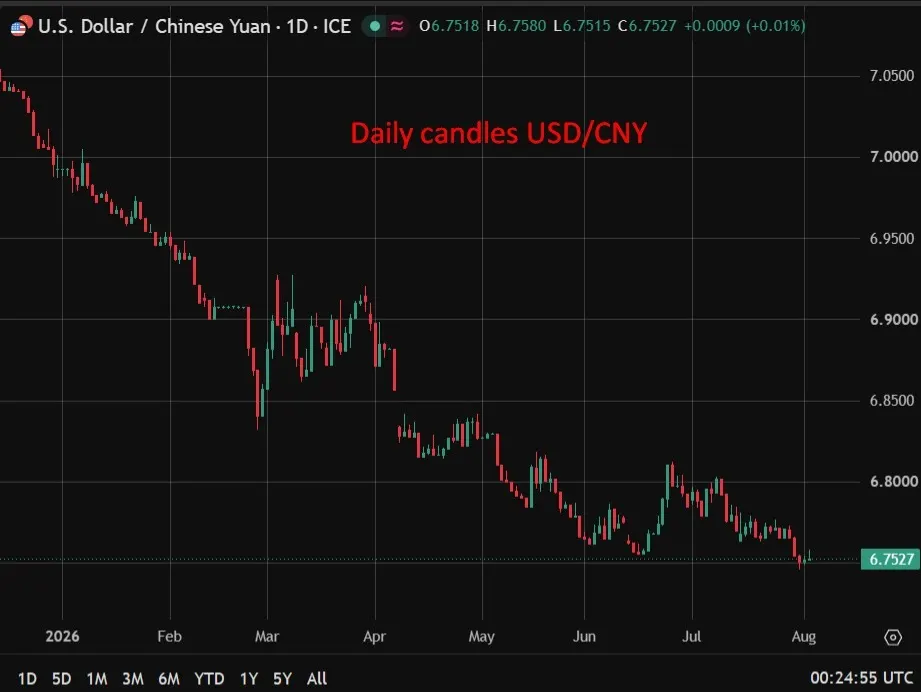
PBOC Expected to Set USD/CNY Reference Rate at 6.7480
The People's Bank of China (PBOC) is anticipated to set the USD/CNY reference rate at approximately 6.7480 during its daily fixing. This rate is closely monitored by market participants as it reflects the central bank's stance on currency management amid varying economic conditions.
The People's Bank of China will announce the daily midpoint, a key indicator for currency traders.
Entities & knowledge links
Executive summary
The People's Bank of China (PBOC) is anticipated to set the USD/CNY reference rate at approximately 6.7480 during its daily fixing. This rate is closely monitored by market participants as it reflects the central bank's stance on currency management amid varying economic conditions.
The People’s Bank of China is due to set the daily USD/CNY reference rate at around 0115 GMT (2115 US Eastern time), a fixing that remains one of the most closely watched signals in Asian foreign exchange markets. China operates a managed floating exchange rate system, under which the renminbi (yuan) is allowed to trade within a prescribed band around a central reference rate, or midpoint, set each trading day by the PBOC. The current trading band permits the currency to move plus or minus 2% from the official midpoint during onshore trading hours.
Each morning, the PBOC determines the midpoint based on a range of inputs. These include the previous day’s closing price, movements in major currencies, particularly the US dollar, broader international FX conditions, and domestic economic considerations such as capital flows, growth momentum, and financial stability objectives. The midpoint is not a purely mechanical calculation, allowing policymakers discretion to guide market expectations.
Once the midpoint is announced, onshore USD/CNY is free to trade within the allowable band. If market pressures push the yuan toward either edge of that range, the central bank may step in to smooth volatility. Intervention can take the form of direct buying or selling of yuan, adjustments to liquidity conditions, or guidance through state-owned banks. As a result, the daily fixing is often interpreted as a policy signal rather than just a technical reference point.
A stronger-than-expected CNY midpoint is typically read as a sign the PBOC is leaning against depreciation pressure, while a weaker fixing for the CNY can indicate tolerance for a softer currency, often in response to dollar strength or domestic economic headwinds. In periods of heightened global volatility, such as shifts in US rate expectations, trade tensions, or capital flow pressures, the fixing takes on added significance. For investors, it provides insight into Beijing’s currency priorities, balancing competitiveness, capital stability, and financial market confidence.
Market impact
This article presents verified public information. Price reaction depends on liquidity and what was already priced in — no directional call is made here.
Institutional framing
TradingBase presents market updates in an institutional financial-news format. This is not investment advice.
Market watch
Track the economic calendar at Economic Calendar, price action at Markets, and signals at Signals.
NIC · Impact scores
Global: 60 · Market: 60 · Urgency: 50 · Confidence: 90 · Neutral
Themes: rates, geopolitics
Asset impact
- USD — Bullish (55) · USD leans bullish based on headline/body drivers.
- Forex — Neutral (55) · Forex mentioned with balanced cues.
Market reaction
- DXY: Price snapshot pending · T-15m / T0 / T+15m / T+60m
- FX: Price snapshot pending · T-15m / T0 / T+15m / T+60m
Trading insight
Analysis only. Not a trade signal. Not investment advice. No Entry/TP/SL is generated by NIC.
Scenarios
- Two-way reaction likely until the market digests the data surprise vs forecast.
- Whipsaw risk is elevated inside the first 15–60 minutes after release.
- For XAUUSD, map USD/rate impulse first, then confirm direction on M15 structure.
Watch factors
- Actual vs forecast surprise (priced-in risk)
- USD / yields impulse if macro-sensitive
- Liquidity and spread during the news window
- Follow-through after T+15m / T+60m
- Relative reaction in usd
- Relative reaction in forex
Related knowledge
PBOC Sets USD/CNY Central Rate at 6.7917, Above Market Estimate
Related news correlation
Bank of Korea to Resume Gold Purchases After 13-Year Hiatus
Related news correlation
US Stocks Reach New Heights Amid Mixed Catalysts
Related news correlation
S&P and NASDAQ Indices Reach New Record Highs
Related news correlation
Federal Reserve Approves Coastal Bend Bancshares Application
Related news correlation
Library
Research depth for related concepts
Ask AI about this article
Answers are grounded in the published article “PBOC Expected to Set USD/CNY Reference Rate at 6.7480” and NIC scores — no invented figures.